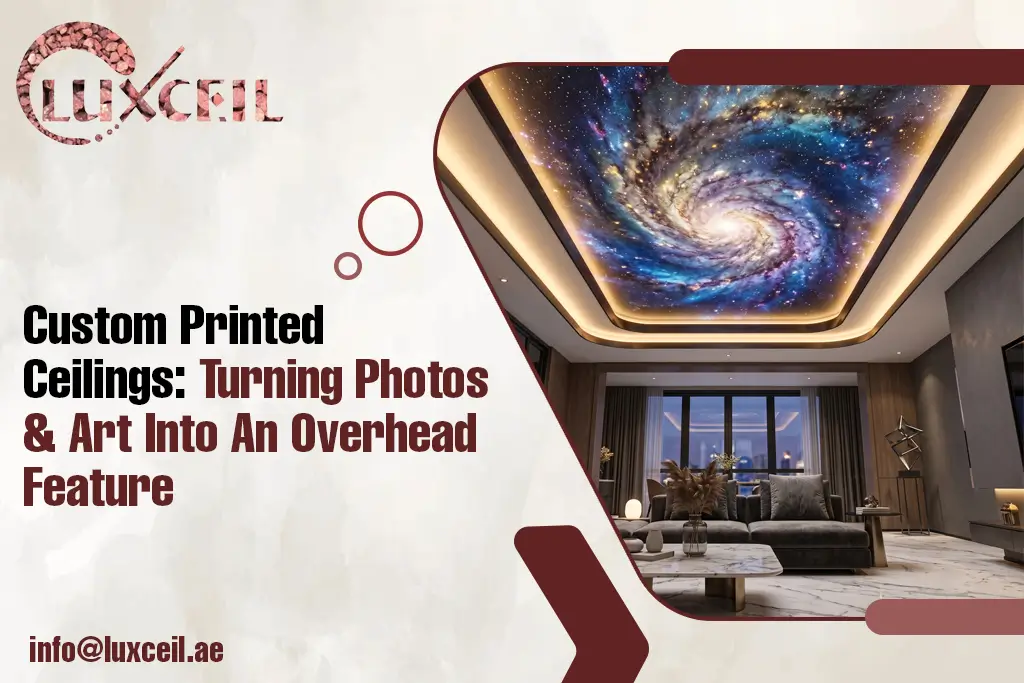
In 2026, stretch ceilings are more than just overhead components. A custom printed ceiling has transformed the architectural landscape. A custom printed ceiling uses the same surface to display an image, a photograph, artwork, pattern, or company logo printed at full size and stretched into place. In this blog, we discuss what a printed stretch ceiling is, what you can print on it, and how the process works from artwork to installation.
What is a Printed Stretch Ceiling?
A stretch ceiling is an ideal false ceiling alternative UAE. It is a thin fabric membrane tensioned into an aluminium track fixed around the perimeter of a room. A printed stretch ceiling is the same system, with your image UV-printed onto the membrane before installation. The print is applied to the material itself, not laid over it. There is no wallpaper to peel, no paint to flake, and no visible fixings. The finished surface is flat, seamless across the panel, and wipeable.
What You Can Print with Custom Printed Ceilings
- Photographs: Skies, clouds, forests, water, desert landscapes, city views, or a client's own photography.
- Artwork and Paintings: Reproductions of classic works, commissioned illustrations, or original pieces by an artist working with the design team.
- Patterns and Textures: Geometric repeats, marble and stone effects, wood grain, traditional Arabic and Islamic geometry, or subtle tonal washes.
- Brand Graphics: Logos, brand patterns and product imagery for showrooms, retail units and reception areas.
- Night Skies: Star fields and constellations, often combined with fibre-optic or LED points of light.
- Solid and Gradient Colours: A printed gradient across a large ceiling is a simple way to add depth without a literal image.
How the Custom Printed Ceiling Process Works
- Brief & Artwork: The custom ceiling design Dubai begins with working alongside the design team and the custom art, photo or creating one.
- Site Measurement: Exact dimensions are taken, along with the positions of lights, sprinklers, AC diffusers, speakers and any other services that will break the surface. These are mapped onto the artwork so nothing important is cut through.
- Layout & Proofing: The image is scaled, cropped and positioned. A printed proof or colour sample is produced so the client can approve the colour before the full panel is run.
- UV Printing: The approved file is printed onto the membrane using UV-cured inks, which resist fading and do not need a laminate over the top.
- Fabrication: A welded harness is fitted around the edge of the membrane so it can be gripped by the perimeter track.
- Installation: The ceiling installation contractor Dubai ensures timely installation. The track is fixed, LED lighting is installed above the membrane if the design is backlit, and the membrane is heated and tensioned into place. Cut-outs for services are formed with reinforcing rings. A room-sized ceiling is usually installed in a day or two, with very little dust or debris.
Getting the image right for Printed Stretch Ceiling
1. Resolution
The file needs to be large enough for the finished size. As a working rule, aim for an image that gives roughly 100–150 DPI at final print dimensions. Send the original file rather than a version downloaded from a website or exported from a phone messaging app, since both compress the image heavily.
2. Colour
Screens display colour differently from printed ink, so a proof is worth the extra day. This matters most for brand colours, which need to match a specified reference rather than simply look close.
3. Base finish
The same image looks different depending on the membrane. A matte base gives even, glare-free colour and suits detailed photography. A satin base adds slight sheen. A gloss base is more reflective and better suited to bold graphics than to fine detail.
4. Adding light behind the print
A printed ceiling can be lit from above. Translucent ceiling Dubai grades transmit around 60% of the light behind them, so an LED array installed in the ceiling void turns the printed image into an illuminated surface.
Why Choose Luxceil?
- Specialists in premium stretch ceiling solutions across Dubai and the UAE
- High-resolution UV printing technology
- Custom artwork and design assistance
- Professional site measurement and installation
- Premium European-quality stretch ceiling materials
- Residential and commercial project expertise
- Fast project completion with minimal disruption
Looking For a Custom Printed Ceiling?
Luxceil is a leading stretch ceiling company in Dubai. We design, print and install custom printed stretch ceilings across Dubai and the UAE, for villas, hotels, showrooms, clinics and commercial interiors. Get in touch with us to discuss your stretch ceiling requirements. Custom printed stretch ceilings offer architects, designers, and property owners the freedom to transform ordinary ceilings into striking visual features. Whether showcasing artwork, corporate branding, or stunning photography, they combine creativity with durability, easy maintenance, and modern installation technology to enhance both residential and commercial interiors.
Frequently Asked Questions (FAQs)
1. Will the print fade?
UV-cured inks are made to resist fading. Ceilings also sit away from direct sunlight in most interiors, which helps. Backlit designs use LEDs, which do not emit the UV that causes fading.
2. Can a printed ceiling be backlit?
Yes. Translucent membranes transmit roughly 60% of the light behind them. Even illumination depends on adequate depth above the membrane and correctly spaced LEDs.
3. Are printed stretch ceilings suitable for UAE humidity?
Yes. The membrane does not absorb moisture, so it does not sag, stain or support mould growth the way a painted gypsum ceiling can.
4. How do you clean a printed ceiling?
A soft cloth with mild detergent is enough. Avoid abrasives and solvents, which can damage the printed surface.
5. Why is anthracite called the highest-grade coal?
Anthracite has the highest carbon content and energy value among all coal ranks, making it the most efficient and clean-burning coal.
6. Which industries use anthracite coal?
Anthracite is widely used in power generation, metallurgy, industrial boilers, cement plants, foundries, and water treatment.
7. Does anthracite produce less ash than other coal?
Yes. Its low ash content reduces residue, improves combustion efficiency, and lowers maintenance requirements.
8. Can anthracite coal replace coke in steel manufacturing?
In many metallurgical applications, anthracite is used as a carbon additive or partial coke replacement due to its high fixed carbon content and low impurities.
9. What should you look for when buying anthracite coal?
Key factors include fixed carbon content, calorific value, ash percentage, sulphur level, moisture content, particle size, and supplier quality.